

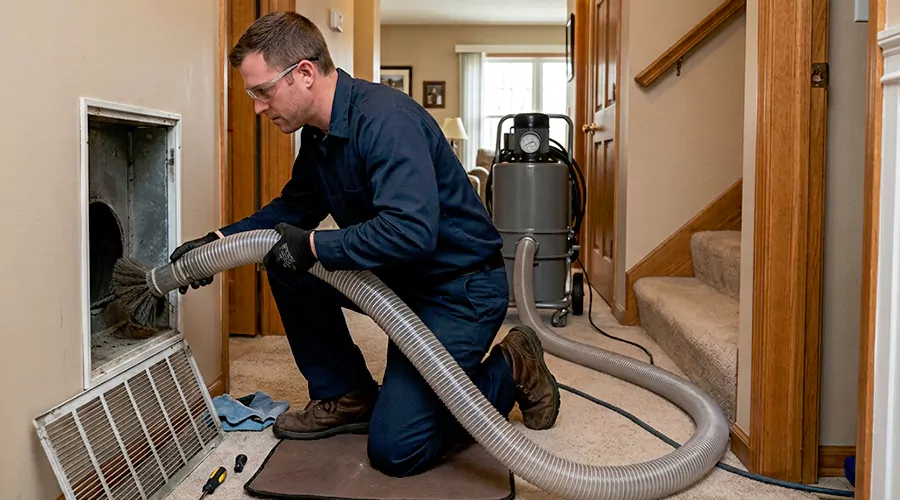
To remove mold around AC vents, first identify and correct the moisture source before cleaning the affected surface. Small amounts of mold on washable exterior vent covers can sometimes be removed with detergent and water. However, suspected contamination inside the ductwork requires a different approach. Mold can begin developing on damp materials within 24 to 48 hours under suitable conditions.
Air conditioning vents sometimes develop moisture because cold supply air lowers the temperature of the grille. When humid indoor air contacts that surface, condensation can form and spread to surrounding ceiling paint or drywall. If moisture continues, mold may grow on dust deposits or other suitable materials.
Removing visible growth without correcting condensation or water intrusion often leads to recurring problems. The proper cleaning method depends on whether contamination is limited to an exterior vent cover or extends into porous building materials. Understanding the difference helps homeowners avoid damaging the HVAC system during cleanup.
Why Does Mold Grow Around AC Vents?
Mold develops around AC vents when moisture repeatedly collects on the grille or surrounding building materials. Condensation is one of the most common causes, but water leaks and damaged duct insulation can produce similar conditions. Identifying the source is necessary because cleaning alone will not prevent growth from returning.
Condensation on Cold Vent Covers
Supply vents become cold when the air conditioning system delivers cooled air into occupied rooms. If the metal grille becomes colder than the surrounding air's dew point, water droplets may form along its edges. This moisture can collect dust and create conditions that support fungal growth.
Condensation is particularly noticeable when indoor humidity remains elevated during cooling operation. A ceiling vent may develop moisture repeatedly while other openings remain dry because of differences in airflow or insulation. If water reaches the surrounding drywall, the affected area can remain damp longer than the metal grille.
Excessive Indoor Humidity
High indoor humidity increases the likelihood of moisture forming on cold AC surfaces. Activities such as showering and cooking introduce water vapor into the home. When ventilation is inadequate, some of that moisture remains in indoor air and can condense on cooler surfaces.
Maintaining indoor relative humidity around 30% to 50% is a useful general target for controlling mold growth. A digital hygrometer can help homeowners monitor humidity during different parts of the day. If readings remain consistently high, the source of excess moisture should be investigated.
Damaged Duct Insulation
Duct insulation helps prevent cold HVAC surfaces from contacting warmer humid air. When insulation is damaged or missing near a ceiling register, condensation may develop around the duct connection. Moisture can then affect the surrounding drywall or collect behind the grille.
This problem is particularly relevant when supply ducts pass through unconditioned attics. The temperature difference between the cooled duct and attic air can be substantial during summer. Repeated condensation may continue until the damaged insulation or connection is corrected.
Water Leaks Near the Vent
Roof leaks and plumbing problems can produce staining that resembles condensation-related mold. Water may travel through ceiling cavities before appearing around an AC vent. In some cases, the grille becomes the most visible location of damage even though the original leak is elsewhere.
A water stain that continues expanding while the AC system is off suggests a possible building leak. Peeling paint or softened drywall provides another clue that moisture has affected surrounding materials. Cleaning the vent cover cannot resolve this type of problem.
How Can You Tell Mold From Dust Around AC Vents?
Dark staining around an AC vent is not always mold. Household particles can accumulate where conditioned air moves across ceilings or walls, creating marks that resemble fungal growth. Moisture and the condition of surrounding materials provide more useful clues than color alone.
Mold may appear as irregular patches on damp surfaces, while ordinary dust often follows airflow patterns. However, these differences are not reliable enough to confirm the material in every case. A musty odor may also indicate moisture contamination without identifying where the growth is located.
| Observation | Possible Cause | Recommended Action |
|---|---|---|
| Dry black streaks around grille | Household dust or soot | Check particle sources and airflow patterns |
| Dark spots on damp vent cover | Possible surface mold | Identify condensation source |
| Peeling paint near ceiling vent | Repeated moisture exposure | Inspect surrounding materials |
| Yellow or brown ceiling stains | Water intrusion | Investigate roof or plumbing leaks |
| Growth extending into duct opening | Possible internal contamination | Avoid disturbance and obtain assessment |
| Recurring water droplets | Condensation | Check humidity and insulation |
A dry stain that follows the edge of a grille does not prove that the duct system contains mold. Similarly, a small visible patch may not reveal the full extent of water damage behind the ceiling. The cleaning method should follow the actual condition of the affected material.
How to Remove Mold Around AC Vents Safely?
Removing a small mold spot from an exterior AC grille requires careful cleaning and complete drying. This approach is suitable only when contamination is limited to a hard washable surface and there is no credible evidence of mold inside the HVAC system. Wet insulation or extensive growth requires a different response.
Step 1. Assess the Size and Location
Begin by examining where the suspected growth appears and whether nearby drywall has been affected. Check if the deposit is limited to a removable metal or plastic grille. Photograph the area before cleaning so you can compare its condition later.
For ordinary household surfaces, EPA guidance indicates that areas smaller than approximately 10 square feet can often be cleaned by homeowners under suitable conditions. However, this guideline does not automatically apply to contamination inside HVAC equipment. Even a smaller affected area requires greater caution when internal duct insulation is involved.
Step 2. Turn Off the Air Conditioning System
Switch off the AC system at the thermostat and wait until airflow stops. This prevents moving air from scattering loose particles while the cover is being handled. Avoid using the fan-only setting to dry suspected contamination because air movement may disturb the material.
If the HVAC system itself is known or credibly suspected to contain mold, keep it off until the condition has been assessed. An isolated spot on the exterior of a grille does not automatically establish internal contamination. The distinction depends on visible evidence and moisture conditions.
Step 3. Wear Suitable Protective Equipment
Use nonporous gloves and eye protection when handling an affected vent cover. A properly fitted N95 respirator can reduce exposure to airborne particles during small cleanup tasks. People with significant mold allergies or weakened immune systems should avoid performing mold cleanup themselves.
Work carefully to prevent dry deposits from becoming airborne. Do not scrape the surface with a stiff brush or use compressed air to dislodge material. The goal is controlled removal rather than scattering particles into the surrounding room.
Step 4. Remove the Exterior Grille if Appropriate
Some AC vent covers are attached with screws and can be removed without opening mechanical equipment. Support the grille while removing the final screw so it does not fall. If the cover is painted into the ceiling, avoid forcing it loose because doing so may damage the surrounding material.
Examine the back of the grille without reaching into the duct. If substantial suspected growth extends inside the opening or affects internal insulation, stop the household cleaning process. Do not pull contaminated material from concealed HVAC components.
Step 5. Clean the Washable Hard Surface
For a small isolated area on a washable hard grille, use mild detergent and water to physically remove the growth. Gently wipe or scrub the affected surface with a suitable soft cloth. Cleaning should remove the material rather than merely change its color.
Avoid applying bleach or disinfectant sprays inside the duct opening. Strong chemical treatments are not necessary for most small hard-surface mold cleanup. Never mix bleach with ammonia or other household cleaning products because dangerous fumes can result.
Step 6. Dry the Cover Completely
After cleaning, remove remaining moisture with a clean towel and allow the grille to dry fully. Water trapped in narrow openings may contribute to corrosion or renewed dampness. Check the underside of the cover before reinstalling it.
Complete drying is particularly important because mold requires moisture to grow. A clean surface that repeatedly becomes wet can develop another problem. The original condensation or water source must therefore be addressed before considering the work finished.
Step 7. Inspect the Surrounding Ceiling
Examine nearby paint and drywall for soft spots or signs of moisture damage. A small washable vent cover can be cleaned differently from porous building materials. Drywall that has become heavily contaminated may not be restorable through ordinary surface wiping.
Avoid painting over active growth or sealing damp surfaces with caulk. These actions conceal the problem without removing the affected material. If contamination appears to extend into the ceiling cavity, further assessment is necessary.
Step 8. Monitor for Recurring Moisture
Once the area is clean and dry, observe the vent during subsequent cooling cycles when it is safe to resume operation. Record whether condensation returns and check indoor humidity with a hygrometer. A recurring wet surface indicates that the underlying cause has not been resolved.
Photographs taken several days apart can help identify changes in staining. If growth returns despite correction of obvious moisture sources, a concealed problem may remain. Repeated chemical treatment is not a substitute for investigating that condition.
Which AC Vent Materials Can Be Cleaned?
The material containing mold determines whether cleaning can restore the affected surface. Nonporous materials such as bare metal and hard plastic are generally easier to clean. Porous materials can retain moisture and contamination within their structure, making complete removal difficult.
| Material | Cleaning Consideration | Recommended Response |
|---|---|---|
| Painted metal grille | Hard washable surface | Gentle physical cleaning if finish is sound |
| Plastic vent cover | Nonporous surface | Mild detergent and complete drying |
| Finished wooden grille | Finish and moisture sensitivity | Assess condition before attempting cleanup |
| Sound painted drywall | Small isolated surface growth | Evaluate carefully and correct moisture |
| Water-damaged drywall | Porous material may retain contamination | Affected material may require removal |
| Fiberglass duct insulation | Mold can grow within fibers | Wet or moldy material generally requires replacement |
A significant distinction exists between a grille and the duct connected to it. Cleaning the cover does not establish that the concealed duct is free of contamination. At the same time, staining on the exterior grille does not automatically mean the entire system requires cleaning.
What Mistakes Should You Avoid When Removing Mold?
Improper cleaning can damage building materials or spread suspected contamination. The most common mistake is treating mold as a stain rather than a moisture problem. Removing discoloration may improve appearance, but growth can return when the surface remains damp.
Avoid these common mistakes:
- Spraying bleach into AC ducts. Chemical sprays may reach materials that cannot be safely rinsed.
- Scrubbing dry growth aggressively. Disturbing deposits can release particles into the room.
- Using a normal vacuum on substantial suspected mold. Ordinary equipment may not control contaminated particles.
- Painting over active growth. Paint does not correct contamination beneath the surface.
- Ignoring condensation. Recurring moisture can support new growth after cleaning.
- Soaking damaged drywall. Additional water can worsen contamination in porous materials.
- Running a contaminated HVAC system. Air movement can distribute material when internal contamination is present.
- Assuming black color identifies mold. Dust and soot can create similar deposits.
Another mistake is treating every stained vent as evidence of widespread HVAC contamination. The extent of the problem must be established before selecting extensive remediation work. The affected area and moisture conditions provide a more reliable basis for deciding what needs attention.
How Much Does Mold Around AC Vents Cost to Fix in 2026?
The cost depends on whether contamination is limited to an exterior grille or extends into building materials. A small washable surface may require only ordinary cleaning supplies, while moisture damage behind a ceiling can involve more extensive repairs. Internal HVAC contamination represents a separate scope of work.
The following figures are broad U.S. cost benchmarks for 2026 rather than fixed prices for a single vent.
| Condition | Possible Work | Estimated Cost |
|---|---|---|
| Small isolated spot on washable cover | Household surface cleaning | Basic cleaning supplies |
| Suspected mold requiring inspection | Mold inspection | $303 to $1,075 |
| Mold inside accessible ductwork | Duct mold remediation | $600 to $2,000 |
| Extensive HVAC contamination | System remediation | $3,000 to $10,000 |
These estimates describe different services and should not be added together automatically. A single surface stain does not justify the cost of full-system remediation. The final scope should depend on confirmed contamination and the amount of material requiring treatment or replacement.
When Should You Call a Professional?
Professional assessment is appropriate when suspected mold extends into HVAC ductwork or affects damaged building materials. Persistent condensation and widespread ceiling contamination also require investigation when their causes cannot be identified through basic observation. The main goal is correcting moisture and determining which materials can be restored safely. Our HVAC inspection service provides the diagnostic testing needed to locate the moisture source.
A qualified HVAC technician can examine duct connections and condensate drainage problems that may be contributing to recurring moisture. When contamination extends into porous materials, a mold remediation specialist may be needed to assess the affected area. Wet or moldy internal fiberglass duct insulation generally cannot be cleaned effectively and should be replaced.
A useful assessment should explain where contamination exists and why moisture is accumulating. Recommendations for whole-system cleaning should be supported by evidence of actual contamination rather than dark staining around one grille. Addressing the source is necessary for lasting control.
How Can You Prevent Mold Around AC Vents From Returning?
Preventing recurring mold requires reducing the moisture that reaches cold AC surfaces. Proper humidity control and sound duct insulation help prevent condensation, while regular maintenance keeps the cooling system's drainage components operating correctly. Surface cleaning is useful but cannot replace these measures.
Maintain Suitable Indoor Humidity
Use a hygrometer to monitor relative humidity and aim for approximately 30% to 50% when practical. Run bathroom exhaust ventilation during showers and reduce activities that create excessive indoor moisture. Persistent readings above the recommended range suggest that additional moisture control may be needed.
Address Condensation Promptly
Check cold supply grilles during humid weather and note whether droplets appear along the edges. Persistent condensation may indicate damaged insulation or unwanted humid air reaching the vent connection. Drying the grille helps in the short term, but repeated moisture requires correction of its cause.
Maintain Cooling Equipment
Follow the HVAC manufacturer's maintenance recommendations and monitor accessible condensate drainage areas for unusual water accumulation. A blocked condensate drain can affect nearby equipment and building materials. Keeping the system properly maintained reduces the likelihood of water remaining where it should not collect.
Inspect Nearby Building Materials
Check ceiling paint and surrounding drywall for new stains during periods of heavy cooling use. Investigate roof or plumbing leaks as soon as they become visible. Water-damaged materials should be dried promptly because mold growth becomes possible when dampness continues.
Conclusion
Removing mold around AC vents requires careful cleaning and correction of the underlying moisture problem. Small growth on washable exterior covers may be manageable, but contamination inside ducts or damaged drywall needs greater caution. Condensation and leaks must be addressed to prevent recurrence. Professional assessment may be necessary when contamination extends beyond accessible surfaces. This week, inspect your vents for dampness and measure indoor humidity.